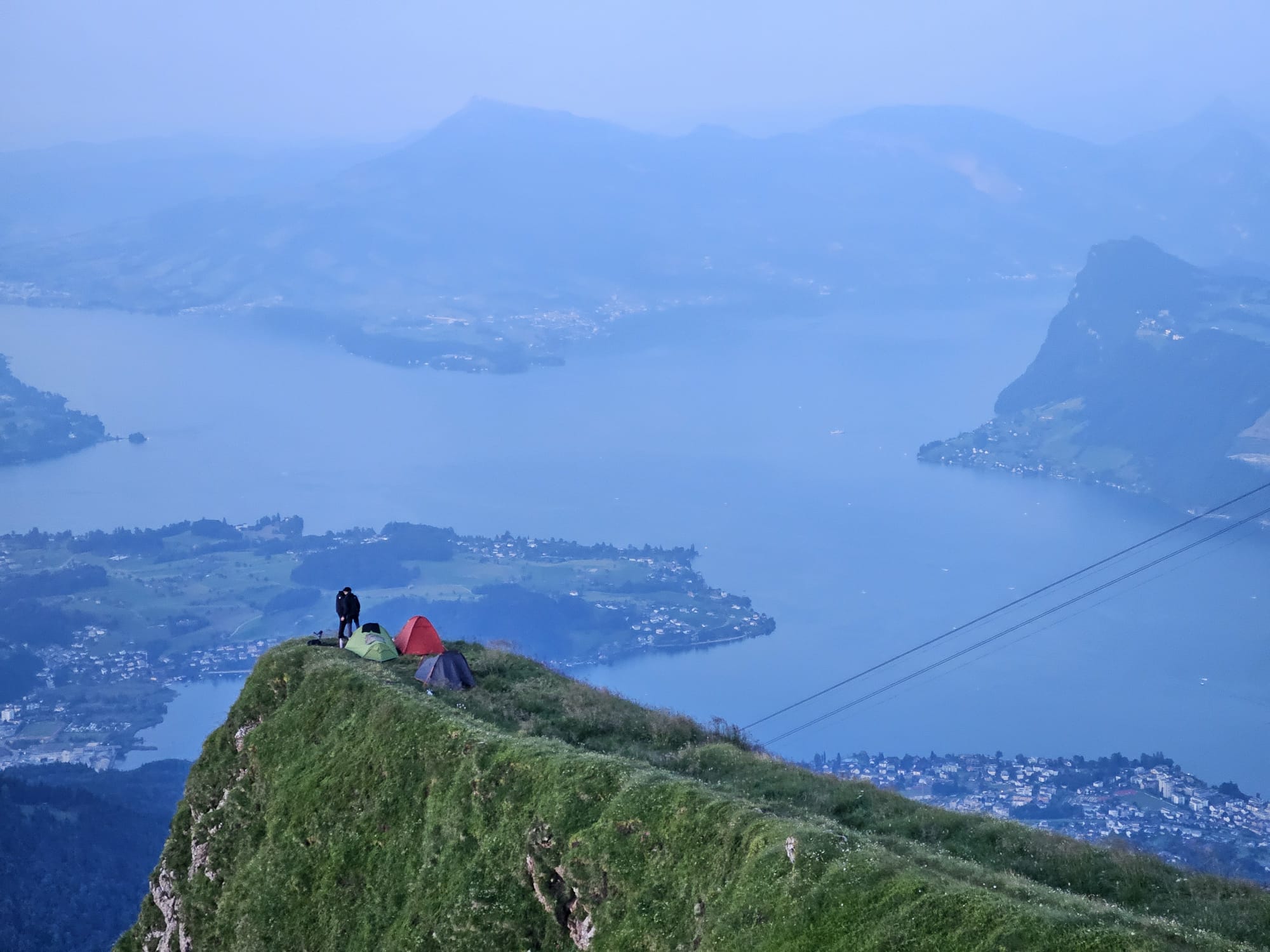
It's high summer, Zürich is baking, and the air in the flat just sits there. My dog is sprawled flat on the tiles and won't move. Those are exactly the days I keep this trip in my back pocket: a bivouac high above Lake Lucerne, where the nights turn cool, the sunrise over the lake is unforgettable, and with a bit of luck ibex wander past at dawn. Klimsenhorn on Mount Pilatus, about two hours from Zürich.
Before you lace up your boots: this is not a casual stroll, and Klimsenhorn is not in Canton Zürich.
Why Klimsenhorn?
Klimsenhorn is a shoulder of Mount Pilatus at roughly 1,907 metres, above Kriens and Lucerne. The highest point of Pilatus is the Tomlishorn at 2,128 metres, but Klimsenhorn has something the main summit doesn't: a flat ridge where you can pitch a tent, with an open view north over Lake Lucerne.
What makes this spot special for a night out:
- The view over Lake Lucerne is enormous. Deep blue water far below, the ranges of central Switzerland behind it.
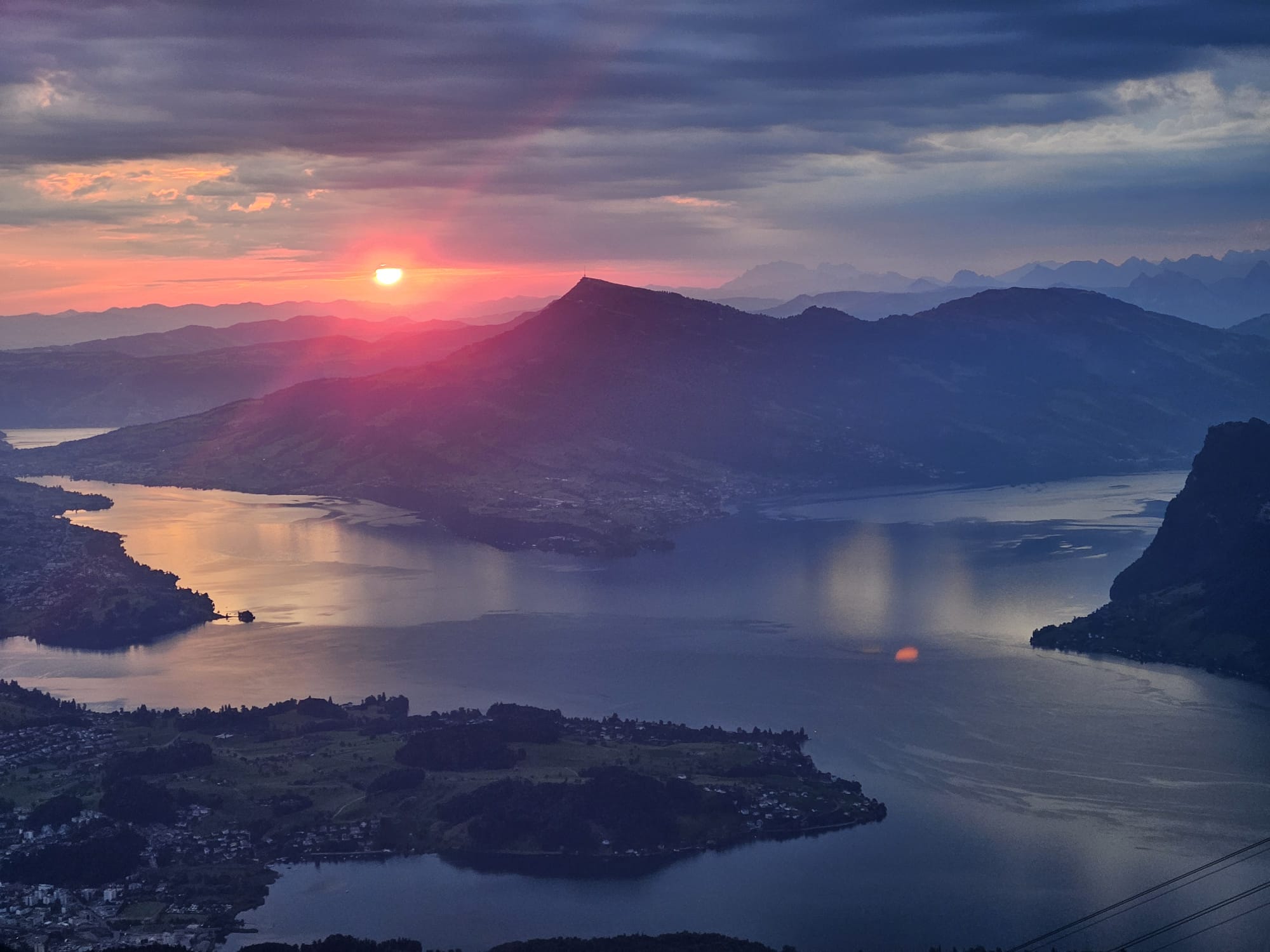
- The sunrise over the lake is the real reason to stay up here overnight. The light creeps slowly across the water, and for a few minutes everything turns pink and gold.
- A short approach with a lift option. You don't have to walk up the whole mountain. The panorama gondola takes you up to Fräkmüntegg, and from there it's a manageable hike to Klimsenhorn.
- A high chance of seeing ibex. Pilatus is home to a colony of around 100 animals. Stay overnight and you're up there at exactly the right time, morning and evening.
Watching ibex without disturbing them
The ibex colony on Pilatus is the quiet highlight of this trip. The best time to see the animals is at dusk and dawn, early morning and late evening. Exactly when the day visitors are long back in the valley and only the overnighters are still up top.
Here's the part that isn't up for debate: your dog has to stay on the leash in this area. Across Switzerland, dogs must be leashed in wildlife protection zones (Wildruhezonen) and nature reserves, and Canton Nidwalden enforces it. But leaving the law aside, the leash belongs on here anyway. Ibex, chamois, and other wildlife react to a loose dog by fleeing, and fleeing across steep terrain burns energy the animals can't spare.
For dogs with a high prey drive, this isn't a recommendation, it's a rule. The area is full of ibex. A dog with prey drive that gets off the leash is a danger to itself, to the wildlife, and on steep, exposed terrain to you as well. For those dogs the rule is simple: never let them off, not even "just for a second." A cable lead and a ground anchor for the overnight camp aren't nice-to-haves here, they're essential kit (more on that in the gear section below).
Watch from a distance. Never approach, never feed, never let the dog run toward wildlife. If you spot ibex, stop, keep the dog close, and enjoy the moment from where you are. For more on leash rules and why they matter most in wildlife areas, see our post on the dog leash law in Zürich and Switzerland.
Wild camping: what's allowed and what isn't
This is the section too many people skip, and then they camp in the wrong place. So, plainly:
Switzerland has no general right to wild camping. The Swiss Alpine Club states that a single-night bivouac above the treeline is tolerated if you behave considerately. Tolerated is not the same as allowed. And there are clear no-go zones: bivouacking is forbidden in wildlife protection zones, nature reserves, and federal game reserves. Around Pilatus there are documented wildlife protection zones, and one of them names Klimsenhorn specifically.
In practice that means:
- Check the wildlife protection zone map for your planned spot before you go. Don't assume it's fine just because other people have camped there.
- Pitch late, strike early. The tent goes up just before dusk and is gone again in the first light. A bivouac is one night, not a weekend.
- Leave no trace. Everything you carry up, you carry back down. No fires, no rubbish, no marks left behind, not even organic scraps.
- One night, one small tent, quiet. The lower your profile, the better for everyone, the wildlife most of all.
The Swiss Alpine Club's official rules on camping and bivouacking are here (in German).
The route: Fräkmüntegg to Klimsenhorn
Our day started late. We took the last gondola up from Kriens, because the camping spot is popular and we didn't want to be hunting for a place in the dark. If you want the best patch on the ridge, get there earlier than we did.
From Kriens, the panorama gondola runs via Krienseregg to Fräkmüntegg (about 18 minutes). That's where the hike begins.
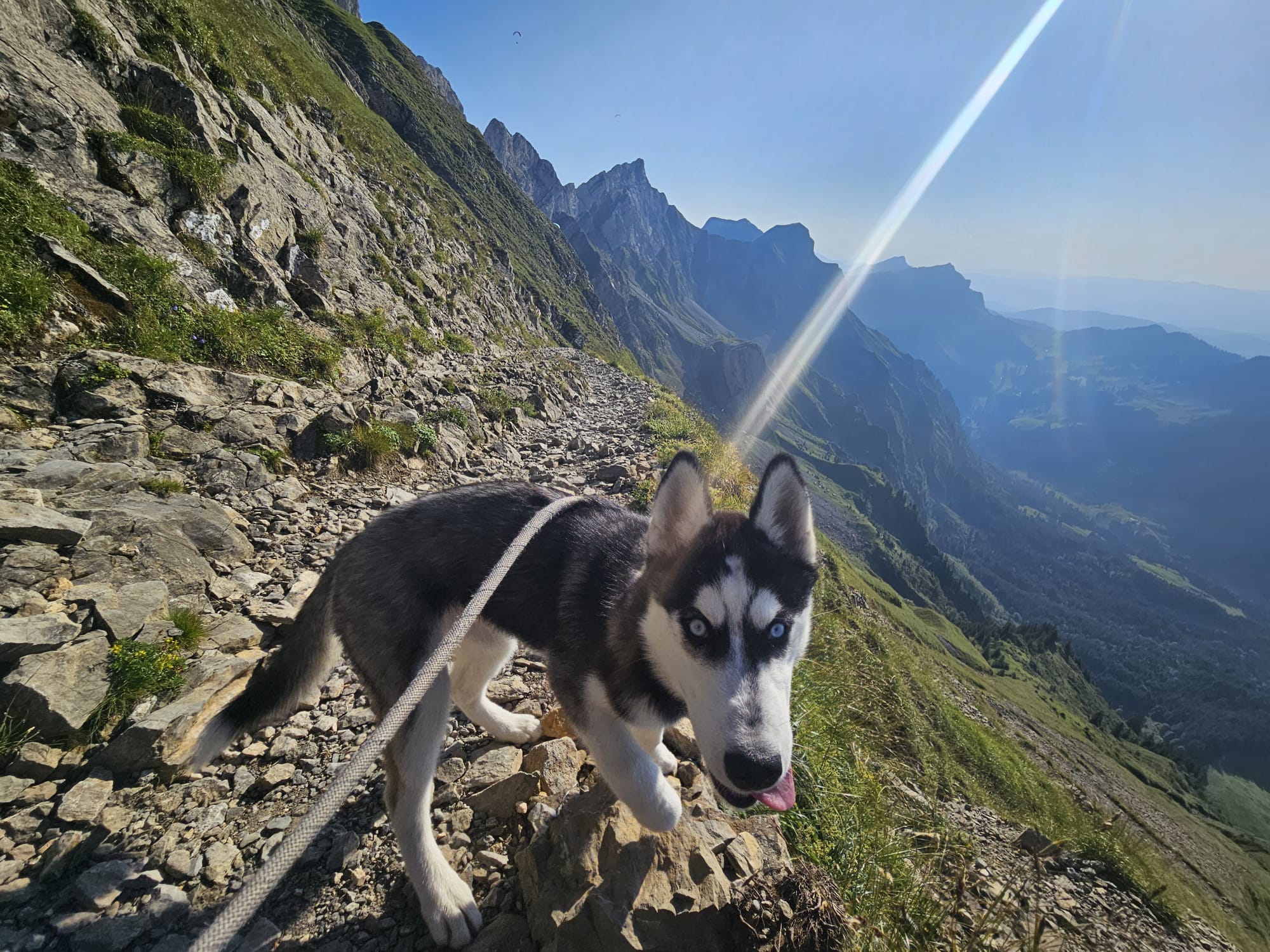
The Fräkmüntegg to Klimsenhorn route is a steep, rewarding, challenging alpine trail of around 5.6 kilometres (roughly 3.5 to 4 hours round trip). You climb a good 600 metres of elevation and pass the historic Klimsen Chapel (built around 1856, renovated in 2004) before reaching the summit area.
Here's how the route went for us:
- Starting point Fräkmüntegg, reachable via the panorama gondola from Kriens.
- The climb heads toward the Klimsensattel across open grassy slopes and steep rock faces. The terrain is varied and exposed in places.
- The final stretch to Klimsenhorn (around 1,907 metres) and the Klimsen Chapel requires sure-footedness. It gets narrow and steep in spots, and a misstep has consequences up here. That's what makes it a T3 route.
The essentials:
- Distance: around 5.6 kilometres round trip
- Elevation gain: around 635 metres
- Difficulty: hard (T3). Requires intermediate alpine experience and good hiking boots.
- Best time: June to October
T3: who this route is for, and who it isn't
On the SAC hiking scale, T3 means demanding mountain hiking: exposed sections, fall-prone terrain, sure-footedness essential. Short secured passages are possible. This is not a route for someone heading into the mountains for the first time, and not for a dog that has never been on alpine terrain.
For you and your dog that means:
- Sure-footedness and some alpine experience are a must. If exposure makes you uneasy, this isn't your hike.
- Your dog should be fit and untroubled by steep, rocky ground. Be honest about whether your dog can handle it, physically and temperamentally.
- Don't go in May. Lingering snow can sit on the trail into late spring, and snow on exposed terrain turns a T3 route into a real hazard.
Heat and water: the single most important point for the dog
You're heading up here to escape the heat, but the climb itself is often in full sun. Dogs regulate heat far worse than we do, and in hot weather their water need almost doubles. As a rough guide: around 80 to 100 millilitres per kilogram of body weight per day in the heat. So a 30 kg dog needs a good 3 litres a day, and for a bivouac you have to carry all of that water up, for yourself and the dog.
How we handle it:
- Start very early, or like us, head up on the last gondola in the late afternoon so the climb doesn't fall in the midday heat.
- Frequent breaks in the shade where there is any.
- Offer water before the dog is panting hard. If it's already panting heavily, you're late.
- Know the signs of heat stress: heavy panting, staggering, a dark red tongue, vomiting. If you suspect it, get into shade immediately, cool the paws and belly with lukewarm water, and end the hike.
What we packed
On top of harness and leash, a bivouac at this altitude needs a fair bit of kit. Here's what we had with us, with the tent in the picture.
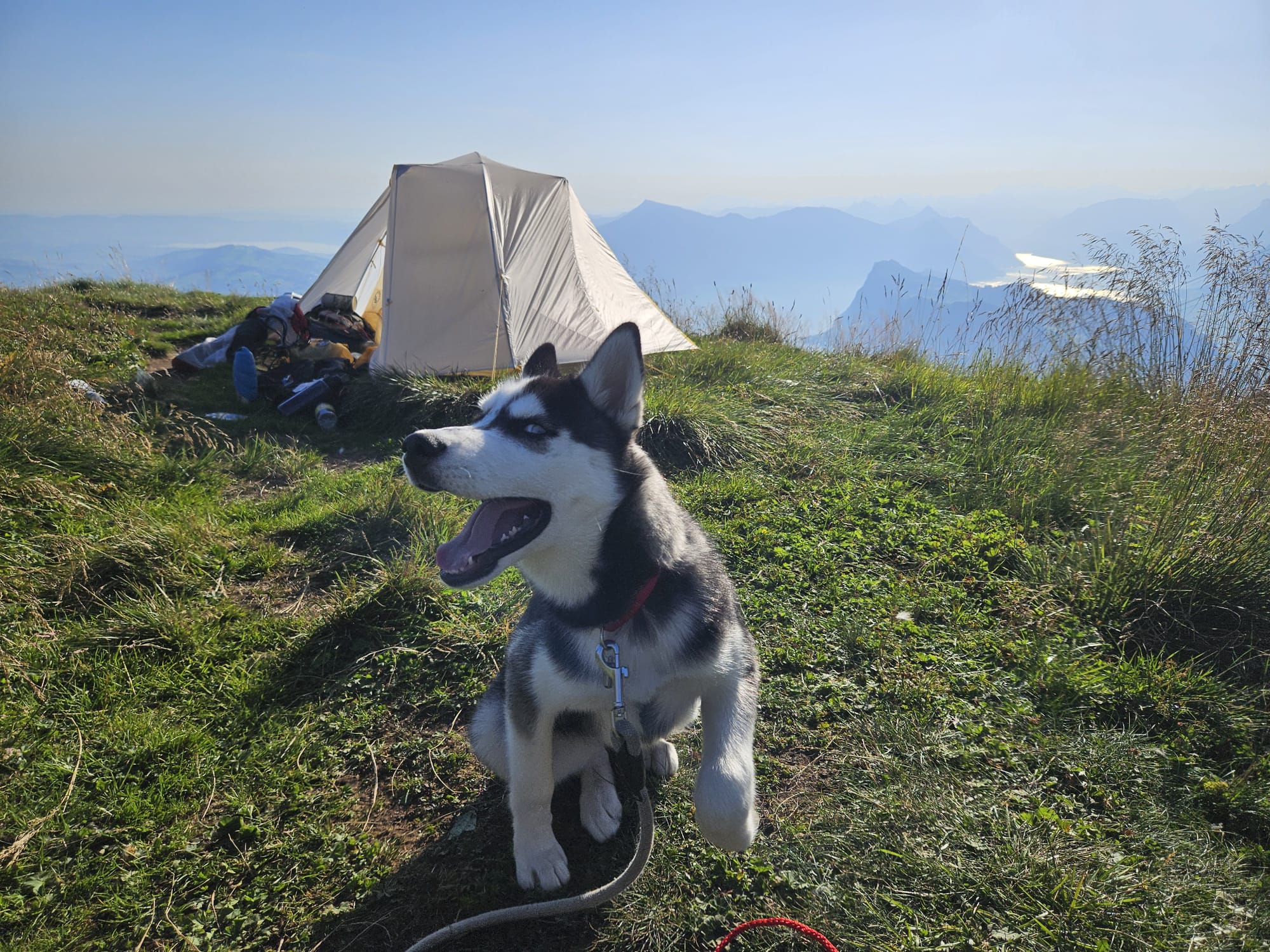
For the dog:
- Enough water for the whole stay, plus a collapsible bottle so the dog can drink on the way up.
- Dog food for the full time up top, factoring in the higher energy need after a long day.
- A dog coat or poncho for the cold nights at altitude. Even in summer it gets sharply cold overnight at nearly 1,900 metres.
- A first aid kit for dog and human.
- A tick remover. A must in Switzerland especially. Tick season runs from spring into autumn.
- For small dogs: a carrier backpack, in case the little paws have had enough partway up.
- A dog rescue sling for emergencies, if the dog gets injured and has to be carried.
- Essential, not optional: a cable lead plus a ground anchor. For tying the dog up safely outside the tent, so it can't chew through the lead overnight and stays secure near you in this wildlife-rich area. For dogs with any prey drive, both are non-negotiable.
Here are the specific products we use or recommend:
If you're only just putting together the basic kit for hiking with a dog, our hiking with a dog in Zürich guide is a good starting point.
Up top: sunset, night, sunrise
We pitched the tent on the flat ridge, at the spot where the sunrise over Lake Lucerne is at its best. The sunset from Klimsenhorn is already the first reward: the light settles warm across the ridges, and the lake slowly changes colour.
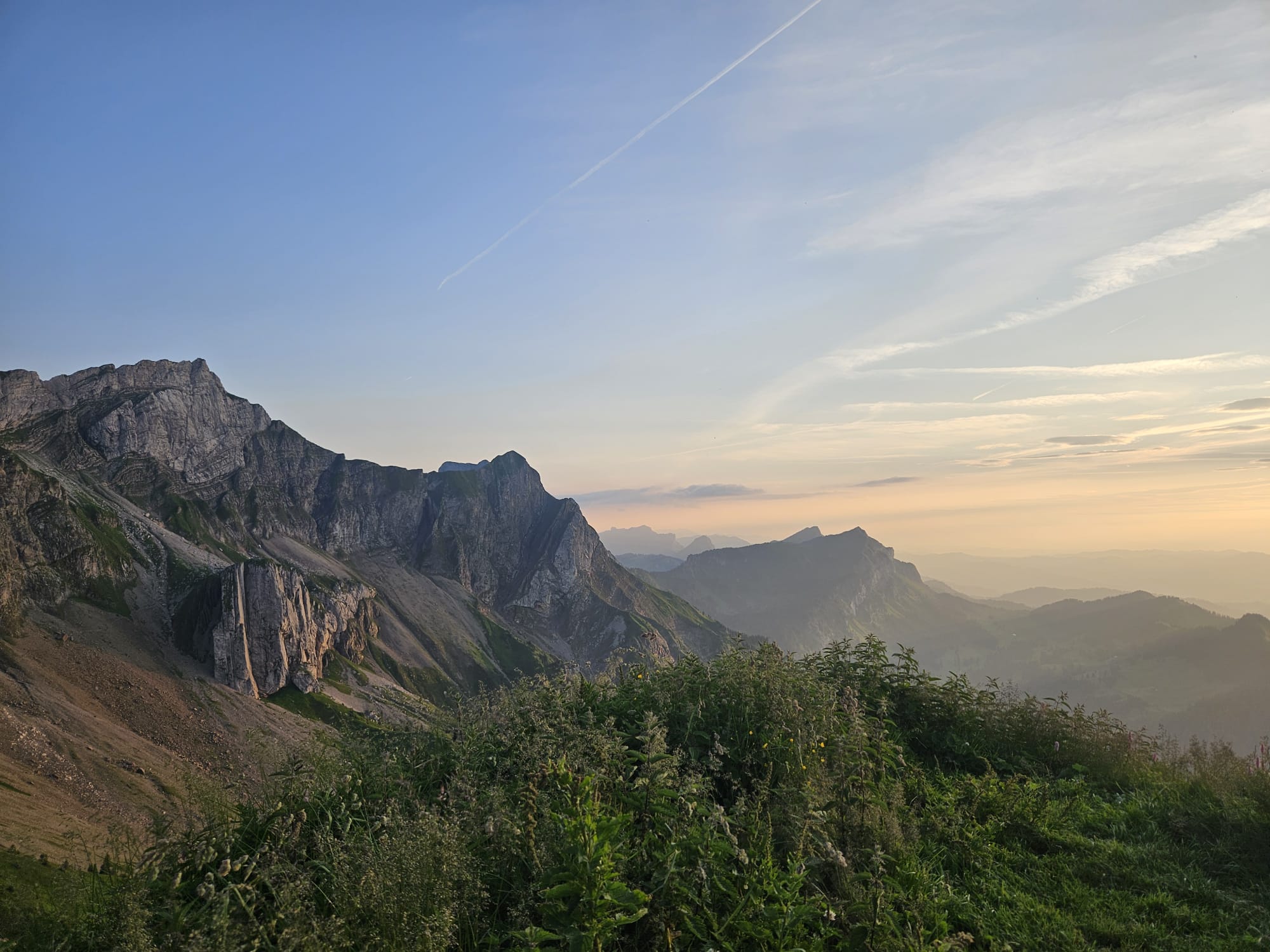
At night it gets cool, quiet, and very dark. The dog sleeps in the poncho next to the sleeping bag, secured to the cable lead. And then, before the first light, the early start pays off: the sunrise over the lake is the reason you put up with all of it. With a bit of luck, the first ibex move across the slopes in exactly those minutes.
Day two: Pilatus summit and the descent
In the morning we struck the tent early, packed everything, and left no trace. Then we carried on to the summit area of Pilatus for a coffee before heading back down.
There are two ways down: walk back, or take the lift in comfort. From Pilatus Kulm the aerial cableway (the Dragon Ride) drops to Fräkmüntegg, and from there the panorama gondola runs back to Kriens. We took the lift.
Important for planning:
- Check timetable and prices first. Current times are on the Pilatus timetable, tickets under Pilatus tickets. For the gondola itself: panorama gondolas.
- Mind the season. The lifts are closed in 2026 from 19 October to 27 November for maintenance. Plan your trip within the season.
Take the free quiz and get your personal compliance plan with exact deadlines.
Start the quiz →In short: what we did
- Last gondola up from Kriens to Fräkmüntegg.
- Hiked Fräkmüntegg to Klimsenhorn, pitched the tent on the flat ridge.
- Spent the night up top, sunset in the evening and sunrise over the lake in the morning.
- Next day, carried on to the Pilatus summit for a coffee, then took the lift down.
If you want another honest alpine trip report with a dog, our Stockflue trip report covers a much harder T5 route in Canton Schwyz, including the spots where the dog simply couldn't go on.
Useful links:
- Pilatus LIVE conditions (check before every trip)
- Pilatus panorama gondolas
- Pilatus timetable
- Pilatus tickets and prices
- Pilatus Ibex Safari
- SAC: camping and bivouacking
- AllTrails: Klimsenhorn
This article contains affiliate links. If you make a purchase, Züri Paw Society earns a small commission at no extra cost to you.
This is a personal trip report, not professional mountaineering advice. Klimsenhorn is in Canton Nidwalden, not Canton Zürich, and dog-specific rules differ from canton to canton. Assess your own dog's fitness and the current conditions honestly before setting out. Every trip is undertaken at your own risk.